If you've toured a listing along Six Forks Road in North Raleigh this year, you've probably heard some version of the same reassurance: the road is finally getting fixed. It's a reasonable thing to believe. The City of Raleigh has been talking about widening Six Forks Road for years, and a project with an eight-figure budget sounds like something that's actually going to happen.
Here's what the city's own project page says as of its most recent update, posted July 28, 2026. After the council already scaled back the original design in February 2024, construction and right-of-way costs kept climbing anyway, and the reduced version now carries an estimated price tag of $93.5 million. Staff concluded that even the smaller plan can't be funded, and recommended shrinking it further, to roughly $7 million in safety-focused improvements between Rowan Street and Millbrook Road. No widened lanes. No relief for the stretch that runs through the North Hills shopping district and then narrows to two lanes north of I-540 before looping past Falls Lake.
That's worth knowing if you're comparing homes in Stonehenge, Bent Tree, or Six Forks North against newer North Raleigh communities that sit off a different corridor entirely. But it's also a useful warm-up for a bigger pattern hiding in the price data for the same neighborhood, one that a lot of buyers are reading backwards right now.
The Widening That Kept Shrinking
A little over a year ago, local news coverage reported that the trimmed-down Six Forks project would break ground in spring 2026 and take about two years to finish. That was already the compromise version. By the time the city posted its most recent update, the compromise had itself become unaffordable, and the fallback plan swapped a widening for a punch list of intersection and multimodal safety tweaks.
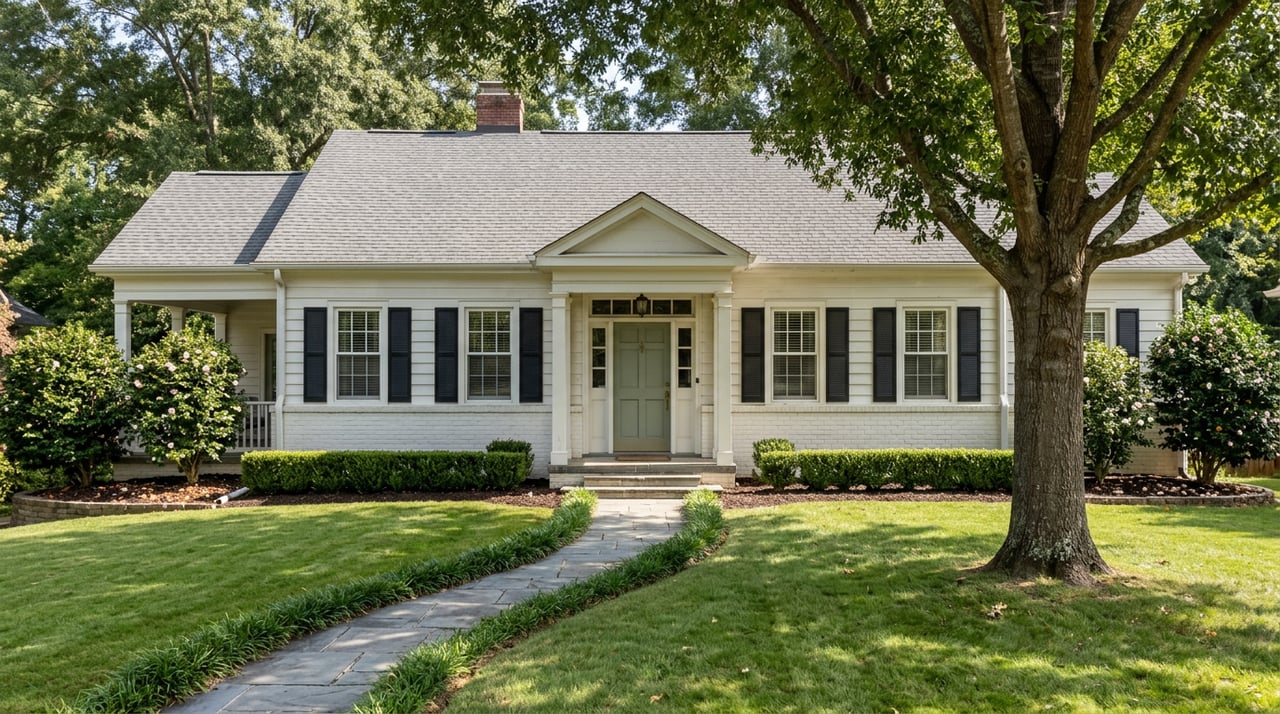
The subdivisions that sit directly on or near that stretch, Stonehenge, Bent Tree, and Six Forks North among them, are some of North Raleigh's most established addresses. Stonehenge in particular is built out with a mix of ranch and colonial-style homes from the 1970s through the 1990s on large, mature lots, and homes there have sold in a median of 23 days over the trailing 12 months. That's fast. It's also a market where the commute reality along Six Forks Road isn't going to change on the timeline a lot of buyers assume, because the number attached to fixing it kept moving in the wrong direction even as the scope kept shrinking.
Keep that shape in mind. It shows up again in the housing numbers themselves.
The Same Trick Is in the Price Data
Over the three months ending June 2026, the median sale price in North Raleigh was $500,000, up 4.1 percent from the same period a year earlier. Read on its own, that sounds like a neighborhood appreciating in a straightforward way. But the median price per square foot over that same window was $236, down 4.3 percent year over year.
Those two numbers cannot both describe the same thing getting more valuable. When the price people are paying per square foot is falling while the overall median is rising, the most likely explanation isn't that homes are worth more. It's that the mix of what's selling has shifted toward bigger properties, the kind of large-lot, established homes you'd find in a neighborhood like Stonehenge or Bent Tree, where square footage runs higher and price per foot has always priced in more land and less new-build premium. More big houses selling pulls the median up even while the market's actual per-foot value is softening.
This matters if you're cross-shopping North Raleigh against other pockets of the city, because the same distortion shows up almost everywhere you look, just at different intensities.
| Submarket | Median sale price (3 mo. ending) | YoY change | Price per sq. ft. | YoY change | Days on market |
|---|---|---|---|---|---|
| North Raleigh | $500K (Jun 2026) | +4.1% | $236 | -4.3% | 27 |
| Northwest Raleigh | $525K (May 2026) | -2.3% | $247 | -1.8% | 29 (vs. 14 a year ago) |
| North Central Raleigh | $860K (May 2026) | +53.5% | $343 | -18.9% | 34 |
| Downtown Raleigh | $525K (May 2026) | +4.4% | $352 | -16.1% | 94 (vs. 60 a year ago) |
| Raleigh citywide | $425K (Jun 2026) | -3.5% | $226 | -3.2% | 33 |
Look at North Central Raleigh's median jump of more than 50 percent alongside a price-per-square-foot drop near 19 percent. That's not a neighborhood getting almost twice as desirable in a year. With only 18 homes selling in the window measured, it's a handful of larger, higher-priced properties changing the average, the same mechanism at work in North Raleigh, just more exaggerated because the sample is smaller. Downtown Raleigh tells a similar story with its own twist. The median rose modestly, but price per square foot fell over 16 percent and homes are sitting for 94 days on average, up from 60 a year ago. A rising median next to a market that's visibly slowing down is a signal to look past the headline number, not lean on it.
Different Corridors, Different Realities
"North Raleigh" isn't one market. It's a label that covers established, tree-canopied subdivisions built out from the 1970s onward and newer master-planned communities built along different roads entirely. Wakefield, for instance, sits well northeast of the Six Forks corridor and has grown up around its own anchor, the Country Club at Wakefield Plantation, a course designed by PGA Tour pros, with the kind of amenity package, pools, tennis courts, walking trails, that a 1980s Stonehenge lot was never designed around. Buyers weighing an established Six Forks-adjacent home against a newer Wakefield-area listing aren't just comparing square footage and price. They're comparing two different commute corridors with two very different infrastructure timelines, and the price-per-square-foot math behaves differently in each.
That's the practical version of the lesson in the table above. A median price tells you what closed. It doesn't tell you what a square foot in a specific pocket of North Raleigh is actually worth this year, and it doesn't tell you whether the road you'll drive twice a day is getting fixed or getting a repaint of the crosswalk lines.
Before you compare two North Raleigh listings on price alone, it's worth asking a few more direct questions:
- What has price per square foot done in this specific subdivision over the past 12 months, not just the broader ZIP code?
- Is the home you're comparing larger or smaller than the recent median for its immediate area? A big lot in an older section can pull a comp upward without reflecting a true premium.
- Which road corridor does this subdivision actually depend on for a daily commute, and what is the real, current status of any planned improvements to it?
- How long have similar homes nearby been sitting on the market? A rising price next to a lengthening days-on-market number, as in Downtown Raleigh, is a different market than a rising price with fast turnover.
Frequently Asked Questions
Is North Raleigh's housing market currently a buyer's market or a seller's market? Based on data through June 2026, North Raleigh homes were selling in about 27 days on average, roughly the same pace as a year earlier, with buyers submitting close to one offer per listing. That points to a market still moving briskly, even as the price-per-square-foot softening described above suggests the gains aren't as broad-based as the median alone implies.
Will the Six Forks Road widening eventually happen? As of the city's most recent public update, staff have recommended a scaled-back set of safety and multimodal improvements between Rowan Street and Millbrook Road, costing an estimated $7 million, rather than the fuller widening once discussed. Anyone buying along that corridor should plan around the current commute, not a future one.
North Raleigh rewards buyers and sellers who look past the headline number, whether that number is a median sale price or a road project's budget line. If you're weighing a move within North Raleigh, or comparing it against Wake Forest, Cary, or Durham, Whalen & Co. can walk you through what the per-square-foot and days-on-market trends actually mean for the specific subdivision you're considering. Request Your Home Valuation to start the conversation with numbers that reflect your street, not just your ZIP code.